Documentation provided by my employer claims that successful projects are delivered by a "One Team" approach, incorporating a DSDM-based project management plan within the organisation.
The roles defined in the project management plan are stated to be flexible in the sense that they may be carried out either internally or externally as appropriate. The roles, and consequently their associated responsibilities may also be shared by multiple individuals.
The following project role diagram aims to illustrate the relationships between individual roles and responsibilities documented within the DSDM development lifecycle specification.
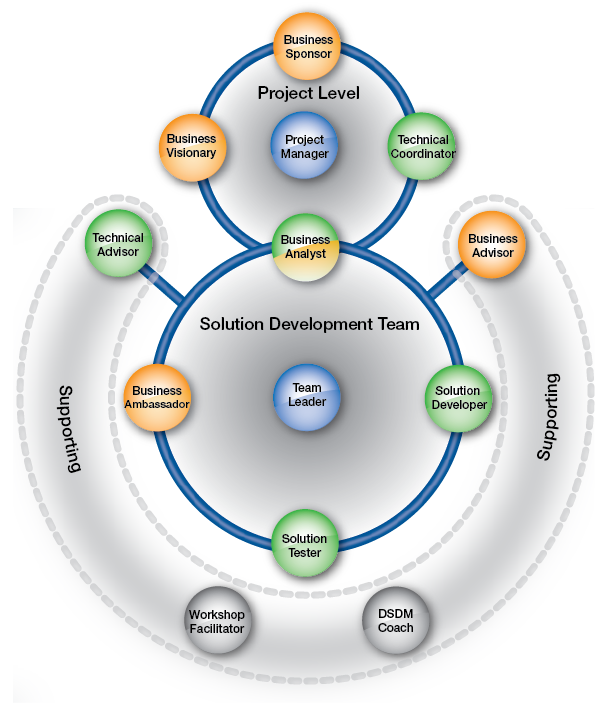
It is stated that a project is goverened by the head, which generally includes the roles of business/project sponsor, improvement champion, project manager and technical co-ordinator.
The various roles generally involved in the project board are documented as follows:
Business Sponsor
The Business Sponsor is the person or entity responsible for providing the funding necessary for any concieved project to be seen through and is as such ultimately accountable for the realisation of that proposed project.
Responsibilities
-
Providing any support necessary for the project team to successfully complete the project
-
Determination and production of the project's underlying development architecture
-
To govern any potential risks involved with the project
-
Engage and govern the communication between the development team and any project stakeholders
-
Ensure that the project stays aligned with the company roadmap throughout its development lifecycle
Improvement Champion
The Improvement Champion is responsible for the delivery of business change and as a result directly supports the Business Sponsor.
Responsibilities
-
Contributing to key requirement, design and review sessions
-
Handling change management. Converting any project vision into a working plan and directing the implementation
-
Ensuring collaboration between those responsible for fulfilling the various management roles and any stakeholders
-
Providing the business vision definition for the project
-
Handling the approval of proposed changes in the requirements definition
Project Manager
The project manager is responsible for the day-to-day running of the project. The manager is accountable to the rest of the project board and is expected to conduct regular project assessments and to report any relevant findings to the project board.
Responsibilities
-
Managing project configuration
-
Manage problems from the solutions development team as they emerge
-
Maintain communication with senior management and project governance authorities throughout the project
-
Maintaining high level project and stage plans
-
Resourcing specialists wherever necessary
Technical Co-Ordinator
The technical co-ordinator is accountable for all technical solutions design within the team. They are also responsible for ensuring that the proposed solution is compliant with the design authority and any other associated standards.
Responsibilities
-
Agreeing on and controlling the development of necessary technical architecture
-
Advising on an co-ordinating the technical activities of each involved team
-
Identifying potential risks associated with any technical and architectural design choices
-
Handling technical aspects of transitioning the produced solution into a live environment
-
Resolve technical differences between technical team members
The body of the DSDM project role diagram depicts all of the people or entities pysically responsible for the production of the proposed project and is actively directed by those responsible for fulfilling the aforementioned management roles.
Team Leader
The team leader is a central role that aims to ensure that the delivery team is working effectively and to communicate progress with project governance.
Responsibilities
-
Focusing the team to ensure appropriate and timely delivery of any agreed solutions
-
To encourage participation and co-operation between team members to ensure the best possible outcome for the project within any provided boundaries
-
Ensuring that the iterative development process is adhered to by the team at all times
-
To monitor the day-to-day development of the team itself through all team activities
-
To organise and run team meetings as often as is necessary and in a timely and focused manner
Business Ambassador
The business ambassador is a support role within the team that aims to provide a business perspective for all decisions potentially related to the solution's fitness for business purpose.
The perspective provided by the business ambassador is generally derived from that of any users of the produced solution.
Responsibilities
-
Providing a business oriented view in all requirement, design and review sessions
-
To provide a business perspective for all day-to-day project decisions
-
Providing daily assurance that the project is evolving as it should be
-
Ensuring the adequacy of any training carried out
-
Communicating with, and involving users with the development process as necessary
Business/Process Analyst
The business analyst aims to develop any project requirements, user storyboards and benefits. They are intended to develop and design business process improvement provisions
Responsibilities
-
Enforcing a high, timely standard of communication between between business and technical participants in the project
-
Managing the design, development and distribution of all products and documentation related to the project's business requirement specifications
-
Ensuring that all of the implications of any day-to-day decisions are taken into account
Business Testers
Business testers aim to test the delivered solution based on any requirements, either functional or otherwise. Ensuring that the project meets the proposed standard and works as intended from the customer's perspective.
Service Managers
The service manager is a role that aims to both run and improve the delivered solution. All responsibilities involved with the operation of the service are those of the service managers.
It is important that a service manager asks questions about any relevant risks or fears that they may have that are associated with the delivered product.
Solution Developer
Designs and develops the solution under guidance of the project's technical co-ordinators. They interpret the project requirement specification and translate it into a functional, working solution as required.
Responsibilities
-
To work with business roles and solution testers to iteratively develop a functional, deployable solution
-
Produce any plans required for the controlled and professional development of the proposed solution
-
To record and interpret any changes to the project requirements or any information likely to impact the development process of the solution
-
Participating in the quality assurance work required to ensure that the delivered product performs as it should
-
To test their own work prior to any independent testing process
Service Transition Manager
The service transition manager is a role that aims to ensure the effective transition from project to service and support. They ensure that the service is ready for change, including any associated documentation and training.
Solution Tester
Solution testers ensure that the delivered solution meets all proposed technical and functional requirements from a technical perspective. The solution testers and fully integrated with the solution development team and work closely to ensure that all technical requirements are met either during or following development.
Responsibilities
-
To work with business roles to define test cases for the solution as it contines to evolve, ensuring that old features are continually regression tested in addition to any newly developed ones
-
To carry out all necessary technical testing of the solution and its features
-
To keep the team leader informed on the results of all testing as is appropriate
-
Creating test products, such as plans, test cases and logs of any past testing
-
Assisting the business ambassadors and advisors to ensure that it is possible for them to accurately validate whether or not the solution is fit for purpose at any one moment in time